
Software Development in the Age of AI: How To Think Like an Engineer When Code Is Cheap
Transform from solo contributor to Software Architect leading an army of AI agents. Learn why deep knowledge of software development best practices is essential for driving standards across the full software development lifecycle and leading AI agent teams effectively.
The Morning I Realized My Job Had Changed
It was 8:47 a.m. on a Saturday morning when I watched Cursor Composer generate a complete authentication service in the time it took me to finish my first cup of coffee. Not just scaffolding—actual, runnable code with error handling, validation, and tests. The same work that would have taken me half a day was sitting in my editor, waiting for review.
That moment crystallized something I'd been sensing for months: the job of a software developer has quietly shifted from typing to architecting. Code generation is no longer the bottleneck. The bottleneck is leadership—knowing how to direct an army of AI agents, set the standards they'll follow, and make architectural decisions that shape entire systems. You're no longer a solo contributor; you're a Software Architect leading a team of AI agents who execute your vision.
Studies on generative AI for developers show that task completion can be dramatically faster when tools like GitHub Copilot are used thoughtfully, though results vary significantly by experience and context 1 2. A 2025 Stack Overflow Developer Survey revealed that 84% of developers are now using or planning to use AI tools in their workflows 3.
At the same time, major reports warn that AI and automation are reshaping whole categories of work, with employers citing AI as both a productivity lever and a reason to restructure teams 4. A Stanford University study found a 13% decline in junior job listings over three years in fields vulnerable to AI, including software development 5.
The uncomfortable reality is that code generation and repetitive implementation are exactly the kinds of tasks most exposed to automation, while higher order problem solving and system design remain stubbornly human 6.
That means your advantage is shifting from "I can write this loop" to "I can architect systems, set development standards, and lead a team of AI agents who execute my vision." You're not just working with AI—you're leading it. Your deep knowledge of software development best practices becomes your leadership toolkit, the standards you enforce, and the architecture decisions that guide your AI agent team.
This is the transformation: You're no longer a solo contributor writing code. You're a Software Architect leading an army of AI agents. Your knowledge of best practices—TDD, architectural patterns, deployment strategies, operational excellence—isn't optional. It's your leadership toolkit. Without it, you can't effectively set standards, make decisions, or review the work your AI agent team produces.
This guide presents how to become the Software Architect who drives standards across the full software development lifecycle, leading an army of AI agents who amplify your expertise rather than replace your judgment.
From Solo Contributor to Software Architect: Leading Your AI Agent Team
When raw code becomes cheap and plentiful, the question "what is actually your job" stops being philosophical and starts being a survival topic.
Traditional Software Development Lifecycle models already emphasize planning, design, implementation, testing, deployment, and maintenance because the industry learned the hard way that code alone is not a product.
AI code tools don't just squeeze the implementation part—they transform you from a solo contributor into a Software Architect leading a team of AI agents. You're no longer writing every line yourself; you're setting the standards, making architectural decisions, and directing an army of AI agents who execute your vision.
This is the critical shift: Your value no longer comes from typing code. It comes from knowing the best practices, architectural patterns, testing strategies, deployment methodologies, and operational principles that you enforce across your AI agent team. You're the architect who drives standards. They're the agents who implement them.
Owning requirements, constraints, tradeoffs, and long term operability is now the difference between being a Software Architect who leads effectively and being someone who gets replaced by better-organized teams.
Your leverage lives in how you frame problems, set testing standards, establish architectural patterns, define deployment strategies, and shepherd systems through their entire lifecycle—all while directing AI agents who execute these standards consistently.
If you keep defining your value as "I personally typed these characters," your role shrinks every time a model gets better at autocomplete and code synthesis.
If instead you become the Software Architect who deeply understands best practices and uses that knowledge to lead an army of AI agents, you can build more ambitious systems while maintaining control over architecture, quality, and long-term operability.
This mindset lays out your role as an architect across eight stages that orbit like a steady convoy of starships around your projects, with you as the commander setting the standards and your AI agents as the fleet executing them.

The Eight-Stage Lifecycle: Your Architecture Command Center
As a Software Architect leading AI agent teams, you Discover what truly needs changing in the world, then Define the specific problem and constraints in clear language that your AI agents, tests, and standards can all understand.
You Design multiple solution options and consciously choose one based on architectural principles, then Develop it by setting testing standards first, directing AI agents second, and reviewing their code third—so correctness is anchored in your established best practices rather than hope.
You Deploy changes with guardrails you've defined, then Operate them in production with observability standards and incident response procedures you've established.
You Evolve systems as the environment, users, and technology change, and eventually you Retire them with deliberate deprecation, migration, and end-of-life steps you've architected.
This lifecycle rhymes with familiar SDLC models but positions you as the Software Architect who drives standards, makes architectural decisions, and leads AI agent teams through every phase. Your deep knowledge of best practices becomes the foundation for everything your AI agents execute.
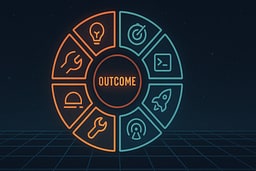
To visualize this shift, imagine a retro starship command center with eight glowing segments around a central "Architecture Standards" core, because that is effectively what you are building: a command center where you set the standards and your AI agent team executes them.
Stage 1: Discover—What Problem Are We Actually Solving?
The Discover stage is where you stop building features just because a ticket exists and start asking what real problem you are trying to change.
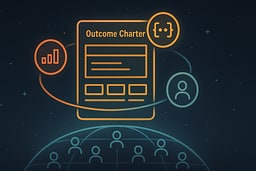
You capture this in an Outcome Charter that names who the work is for, what hurts them now, and what will be observably different when you succeed.
Outcome Charter Template:
For: [Who is affected?]
Problem: [What specific pain or friction exists today?]
Success looks like: [Measurable outcome—faster, fewer errors, better conversion, etc.]
Constraints: [Deadlines, tech stack, regulations, legacy systems]
Out of scope: [What we're explicitly not solving]
Success might show up as faster task completion, fewer failed logins, better conversion, or fewer late-night pages, but it must be phrased as something you can actually measure.
Constraints like deadlines, tech-stack limitations, regulatory requirements, and "do not disturb" legacy systems are listed explicitly instead of being left as vague background stress.
Anything that cannot justify itself in outcomes and constraints should probably not advance to full engineering attention, however shiny it looks in the backlog.
You can direct your AI agent team to brainstorm alternative framings or risks, but you remain the Software Architect who decides which outcome is worth steering the ship toward. Your role is to set the direction; their role is to explore options within your constraints.
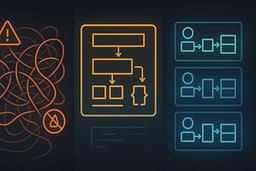
Stage 2: Define—Turning Outcomes into Testable Problems
Define takes "we want better performance" and turns it into something that will not generate endless arguments halfway through the sprint.
You create a Problem Frame Canvas that describes current behavior in concrete terms like error rates, latencies, and failure modes instead of vague complaints.
Problem Frame Canvas Template:
Current State:
- Behavior: [What happens now?]
- Metrics: [Error rate: X%, Latency: Yms, Failure mode: Z]
- Who is affected: [Users, systems, business]

Target State:
- Behavior: [What should happen?]
- Metrics: [Target error rate: X%, Latency: Yms]
- Edge cases: [Partial failures, weird inputs, boundary conditions]

Invariants (must always hold):
- [ ] No charge without an order
- [ ] No data crossing boundary X
- [ ] No logging of sensitive fields

Out of scope: [What we're not solving in this iteration]
You describe the target behavior with similar precision, including constraints for edge cases, partial failures, and weird inputs that historically show up only after launch.
You document invariants that must always hold, such as "no charge without an order," "no data crossing boundary X," or "no logging of sensitive fields," so everyone knows the lines in the sand.
You also explicitly mark what is out of scope, which is the part most teams forget and then rediscover during painful scope creep arguments.
Your AI agent team can help you probe for missing edge cases and generate lists of risks, but all of those still feed back into this crisp, architect-owned framing. You're the one who understands the domain, the constraints, and the tradeoffs—they're the ones who help you explore the space systematically.
Stage 3: Design—Exploring Options Before Committing
Design is where you resist falling in love with your first idea and instead build an Option Stack like a collection of labeled starship blueprints on the table.
You deliberately sketch at least two or three viable designs, such as a minimal patch, a robust medium-term approach, and a bold long-term refactor.
Option Stack Template:
Option 1: [Minimal Patch]
- Benefits: [Quick wins, low risk]
- Risks: [Technical debt, scalability limits]
- Complexity: [Low/Medium/High]
- Cost: [Time, resources, dependencies]
- Becomes wrong when: [Data grows 10x, team doubles, etc.]

Option 2: [Robust Medium-Term]
- Benefits: [Scalable, maintainable]
- Risks: [Longer timeline, more moving parts]
- Complexity: [Low/Medium/High]
- Cost: [Time, resources, dependencies]
- Becomes wrong when: [Regulatory changes, dependency drift]

Option 3: [Bold Long-Term Refactor]
- Benefits: [Future-proof, elegant]
- Risks: [High risk, long timeline]
- Complexity: [Low/Medium/High]
- Cost: [Time, resources, dependencies]
- Becomes wrong when: [Business pivot, technology shift]

Decision: [Which option and why]
Decision Record: [Context, tradeoffs, who agreed, date]
For each option you write down benefits, risks, complexity, and cost so you are not relying on gut feelings and whoever speaks last in the meeting.
You decide when each option becomes clearly wrong, based on things like data growth, team size, regulatory changes, or dependency drift.
You log the final choice in a Decision Record with context, options considered, tradeoffs accepted, and names of people who agreed, so future you does not have to play archeologist.
Decision Record Template:
Date: [YYYY-MM-DD]
Context: [What situation required this decision?]
Options Considered: [List options from Option Stack]
Chosen: [Which option and why]
Tradeoffs Accepted: [What we're giving up]
Assumptions: [What we're assuming to be true]
Who Decided: [Names of decision-makers]
Review Date: [When to revisit this decision]
Your AI agent team is very good at playing the critic here by imagining load scenarios, failure cascades, and alternative arrangements, but you are still the Software Architect who must choose the path and own the consequences. Your knowledge of architectural patterns, scalability principles, and system design is what enables you to evaluate their suggestions and make the right decision.
Once a design is chosen with eyes open, you can move confidently into Develop, knowing your implementation has a clear rationale behind it rather than just "it felt right at the time."

Stage 4: Develop—Setting Standards, Leading AI Agents, Reviewing Code
Development starts before any function body appears, with a Test Intent Sheet that explains how the system should behave from the outside. This test-first approach, rooted in Test-Driven Development (TDD), has been shown to improve code quality, reduce defect rates, and create more maintainable systems 9 10.
This is where your knowledge of best practices becomes your leadership toolkit. You can't effectively direct AI agents to write tests if you don't understand TDD principles yourself. You can't enforce code quality standards if you don't know what good code looks like. You can't review AI-generated code if you can't recognize architectural patterns, design smells, or security vulnerabilities.
As the Software Architect, you set the testing standards, define the code quality criteria, establish the architectural patterns, and then direct your AI agent team to implement them. Your deep understanding of best practices is what makes you an effective leader.
Test Intent Sheet Template:
Acceptance Scenarios:
- [ ] Happy path: [Normal operation]
- [ ] Edge case: [Boundary conditions]
- [ ] Error case: [Failure modes]
- [ ] Security: [Unauthorized access, injection, etc.]

Non-Functional Requirements:
- Latency: [Target: Xms, Max: Yms]
- Throughput: [Target: X req/s]
- Resource limits: [Memory, CPU, storage]
- Security: [Encryption, validation, audit logging]

Test Layers:
- Unit: [Core logic, pure functions]
- Integration: [Service boundaries, databases]
- Contract: [API contracts, data formats]
- E2E: [Critical user flows]

AI Prompt Strategy: [How you'll guide AI to generate tests]
You write down acceptance scenarios, edge cases, and non-functional expectations like latency limits, throughput ranges, and security constraints that would make security teams sleep a little easier.
You map which tests belong at which layer, from unit tests for core logic to integration and contract tests at boundaries, and end-to-end checks for critical flows. This knowledge of testing strategies is essential—you can't direct AI agents effectively if you don't understand the testing pyramid, when to use mocks, or how to structure integration tests.
Only when your standards are clear do you direct your AI agent team to generate test code that expresses these scenarios in your chosen framework. You're not just asking for tests—you're enforcing your testing standards.
You review and refine AI-generated tests, tightening assertions and removing anything that encourages brittle behavior or blind trust. Your ability to recognize good tests from bad ones comes from understanding testing best practices. Without this knowledge, you can't effectively lead your AI agent team.
Then you direct your AI agents to generate implementation code that passes those tests, treating them as eager but literal team members who need your architectural guidance and domain knowledge to stay on course.
With your standards leading and your AI agent team executing, you can transition into Deploy with a codebase that expresses your architectural intent instead of one that merely passed local builds.
Stage 5: Deploy—Making Boring, Predictable, and Reversible
Deploy is the stage where you stop confusing "merged to main" with "safely running in production."
You define a Rollout Plan that might include feature flags, canary releases, or blue–green deployments depending on risk and blast radius.
Rollout Plan Template:
Rollout Strategy: [Feature flag / Canary / Blue-Green / Full]
Risk Level: [Low / Medium / High]
Blast Radius: [How many users/systems affected?]

Phase 1: [Internal / Staging]
- Advancement criteria: [Error rate < X%, Latency < Yms]
- Rollback trigger: [Error rate > X%, Latency > Yms]
- Duration: [How long to observe]

Phase 2: [Limited Production]
- Advancement criteria: [Same as Phase 1]
- Rollback trigger: [Same as Phase 1]
- Duration: [How long to observe]
- Traffic percentage: [X% of users]

Phase 3: [Full Production]
- Monitoring: [Dashboards, alerts, runbooks]
- Rollback plan: [How to revert]

Safety Net Checklist:
- [ ] Feature flags configured
- [ ] Rollback procedure tested
- [ ] Dashboards visible
- [ ] Alerts configured
- [ ] Runbook updated
- [ ] On-call engineer notified
For each phase of rollout you spell out advancement criteria like stable error rates and latency thresholds, and rollback criteria that are triggered automatically or by clear thresholds rather than drama.
You build a Safety Net Checklist that ensures toggles, revert strategies, dashboards, and alerts are in place before you press the big glowing button.
Your AI agent team can help generate runbooks, suggest metrics based on your architecture, and summarize what a safe deployment strategy should look like for your kind of change. But your knowledge of deployment best practices—blue-green deployments, canary releases, feature flags, rollback strategies—is what allows you to evaluate their suggestions and set the standards they'll follow.
The point is not to make deployment glamorous but to make it boring, predictable, and reversible when something unexpected shows up in logs.

Stage 6: Operate—Where Real Behavior Reveals Itself
Once changes are safely in the wild, you walk directly into Operate, where the real behavior of your system finally starts to reveal itself.
Operate begins the moment real users and real traffic hit your system and do things your tests never quite imagined.
You maintain a Health Snapshot that tracks technical metrics like latency, throughput, and error rates alongside business metrics like task success, revenue, or engagement.
Health Snapshot Template:
Date: [YYYY-MM-DD]
Technical Metrics:
- Latency (p50/p95/p99): [Xms / Yms / Zms]
- Throughput: [X req/s]
- Error rate: [X%]
- Resource usage: [CPU: X%, Memory: Y%, Disk: Z%]

Business Metrics:
- Task success rate: [X%]
- User engagement: [X active users]
- Revenue impact: [If applicable]
- Conversion rate: [If applicable]

Trends: [Up/Down/Stable compared to last period]
Anomalies: [Any unusual patterns?]
Action Items: [What needs attention?]
Regular reviews of this snapshot let you see trends and anomalies early rather than learning only when an executive forwards a customer complaint.
When incidents happen, and they always do eventually, you record them in an Incident Diary with symptoms, impact, hypotheses, experiments, root cause, and follow-ups.
Incident Diary Template:
Incident ID: [Unique identifier]
Date/Time: [When it started / When it ended]
Duration: [How long it lasted]
Impact: [Users affected, revenue lost, systems down]

Symptoms:
- [What was observed?]
- [Error messages, logs, metrics]

Hypotheses:
1. [Initial theory]
2. [Alternative theory]
3. [Another possibility]

Experiments:
- [What did we try?]
- [What worked / didn't work?]

Root Cause: [What actually caused it?]
Resolution: [How was it fixed?]
Follow-ups:
- [ ] Action item 1
- [ ] Action item 2
- [ ] Action item 3

Lessons Learned: [What would we do differently?]
Your AI agent team can help summarize logs, cluster related incidents, and even suggest likely culprits, but they still need your architectural guidance to decide which signals are meaningful. Your understanding of system architecture, failure modes, and operational patterns is what enables you to interpret their analysis and make the right decisions.
Treating operations as a first-class phase keeps your system from turning into a haunted ruin that everyone is afraid to touch or modify.
Stage 7: Evolve—Adapting to the World You Discovered
Those operational insights feed directly into Evolve, where you decide how to adapt the system to the world you actually discovered, not the one you assumed in the design doc.
Evolve is about asking whether the system you built still fits the environment it lives in today.
You maintain a Refactor Opportunity List that collects hotspots of complexity, fragility, or duplication that repeatedly cost time or cause incidents.
Refactor Opportunity List Template:
Hotspot: [File, module, or pattern]
Problem: [Why is this a problem?]
Impact: [How often does it cause issues?]
Effort: [Low / Medium / High]
Priority: [Low / Medium / High]
Notes: [Additional context]
You also maintain an Extension Map that clarifies which new features belong in this system and which deserve their own services, queues, or modules instead of cramming everything into one giant hull.
Extension Map Template:
New Feature: [Description]
Fits in current system: [Yes / No / Maybe]
Reasoning: [Why or why not]
If separate: [What would it be? Service / Queue / Module]
Dependencies: [What does it need?]
For each change you decide whether you are refactoring internals, extending behavior, or containing scope by explicitly saying no or splitting concerns.
Your AI agent team can propose refactors, identify duplicated patterns, and even draft new module structures, but you decide which changes are worth the risk and effort. Your knowledge of refactoring techniques, design patterns, and technical debt management is what enables you to evaluate their suggestions and make architectural decisions that balance short-term needs with long-term maintainability.
Small refactors tied to real work prevent the codebase from becoming a museum of past frameworks and panicked quick-fixes no one fully understands anymore.
Stage 8: Retire—Respectful End-of-Life
Eventually, repeated evolution and changing needs lead naturally into Retire, where systems get a respectful end-of-life instead of a random unplugging.
Retire is the phase every system reaches eventually, even if no one scheduled it on a roadmap.
You start with Deprecation by clearly announcing what will be turned off, why, and on what timeline, with enough detail that consumers can actually plan.
Deprecation Announcement Template:
Service/API: [What is being deprecated]
Reason: [Why is it being retired?]
Timeline:
- Announcement: [Date]
- Deprecation: [Date - no new integrations]
- End of Life: [Date - service stops]
- Data deletion: [Date - if applicable]

Migration Path:
- New service: [What replaces it?]
- Migration guide: [Link to documentation]
- Support: [How to get help]

Contact: [Who to reach out to]
You publish a Migration Guide that shows old versus new behaviors, mapping paths, and concrete steps for teams to move without guesswork.
Migration Guide Template:
Old Behavior: [How it worked before]
New Behavior: [How it works now]
Mapping: [Old → New]
Steps:
1. [First step]
2. [Second step]
3. [Third step]

Common Issues: [What to watch out for]
Support: [How to get help]
You track adoption and migration progress like a real project, offering support and adjusting the plan based on how reality diverges from your original assumptions.
End-of-life then becomes a runbook of draining traffic, decommissioning resources, archiving or deleting data, and updating documentation so no one is surprised when the old endpoint stops responding.
Seen this way, retiring a system is not an admission of failure but a sign that needs, technology, or strategy have changed and you chose to act deliberately instead of waiting for entropy.
Why Best Practices Knowledge Is Essential for Leading AI Agents
Once you embrace the full loop from Discover through Retire, the question becomes: Why do you need to know best practices if AI agents can implement them?
The answer is simple: You can't lead what you don't understand. You can't set standards you don't know. You can't review code you can't evaluate. You can't make architectural decisions you can't reason about.
The Leadership Paradox
There's a paradox in the AI era: the more AI agents can do, the more you need to understand the underlying principles to lead them effectively. Here's why:
You set the standards. AI agents don't know what "good code" means unless you define it. They don't know when to use TDD vs. integration tests unless you establish the criteria. They don't know which architectural pattern fits unless you make that decision. Your knowledge of best practices becomes the standards you enforce.
You make the architectural decisions. AI agents can generate code for multiple patterns, but they can't decide which pattern fits your context, constraints, and long-term goals. That decision requires understanding tradeoffs, scalability implications, and maintenance costs—knowledge that comes from deep understanding of software architecture.
You review and refine. AI agents generate code, but you review it for correctness, maintainability, security, and alignment with your standards. Without understanding best practices, you can't recognize when AI-generated code violates principles, introduces technical debt, or creates security vulnerabilities.
You lead the team. You're not a solo contributor anymore—you're leading an army of AI agents. Leadership requires understanding what you're asking your team to do. You can't effectively direct AI agents to implement microservices architecture if you don't understand when and why to use it. You can't enforce deployment standards if you don't understand blue-green deployments, canary releases, or feature flags.
The Human Skills That Keep You Indispensable
Once you understand that you're now a Software Architect leading AI agent teams, the question becomes how to grow the skills and habits that make you an effective leader in every phase.

Journaling: Your Compounding Asset
Journaling is one of those deceptively simple habits that quietly supercharges nearly everything else in this lifecycle.
Research on reflective journaling shows that regularly writing about your work enhances self-awareness, decision-making, and professional growth across many fields 7 8. In software engineering specifically, maintaining a development journal helps engineers identify patterns, learn from mistakes, and make better architectural decisions over time.
In practical terms, an engineering journal captures what you intended to do, what actually happened, and what you learned, rather than just a list of commits or bug IDs.
Engineering Journal Entry Template:
Date: [YYYY-MM-DD]
Project: [What are you working on?]

Intent: [What did you plan to do?]
Reality: [What actually happened?]
Learning: [What did you discover?]

Patterns: [Any recurring themes?]
Energy: [What drained / energized you?]
Next Steps: [What will you do differently?]
Over time those entries reveal patterns you would otherwise miss, such as where you consistently underestimate complexity or which types of tasks drain your energy.
Journaling also creates emotional distance by turning "I failed" into "this design failed because we misunderstood constraint X," which is actually something you can improve.
When selectively shared, journal excerpts become real mentoring material that shows juniors how you navigated confusion, tradeoffs, and incidents instead of only presenting flawless diagrams.
Once journaling becomes normal, it naturally supports other skills like reading, domain modeling, and decision hygiene because you have somewhere to store and inspect your thinking.
Reading: The High-Leverage Skill AI Can't Take
Reading might sound too basic to mention, but in complex systems it becomes a high-leverage skill that AI cannot take away from you.
Reading unfamiliar code effectively means tracing entrypoints, following data through its transformations, and building small mental maps instead of trying to swallow the repository whole.
Code Reading Strategy:
- Find the entry point: Where does execution start?
- Follow the data: How does data flow through the system?
- Map the boundaries: What are the external dependencies?
- Identify invariants: What must always be true?
- Document your understanding: Write it down as you learn
Reading logs and dashboards is about reconstructing a story of user actions and system responses rather than staring at numbers until they blur into one long alarm.
Reading AI-generated code or explanations requires a different kind of skepticism, looking for hidden assumptions, missing edge cases, and domain mismatches.
Domain modeling adds another layer as you identify entities, relationships, and invariants that define what "correct" even means in your context.
Domain Modeling Questions:
- What are the core entities?
- What are the relationships between them?
- What invariants must always hold?
- What are the boundaries?
- What are the failure modes?
Many difficult production bugs boil down to bad domain understanding, such as incorrectly modeled timelines, money flows, or user states.
By summarizing what you read and model in your journal, you gradually turn scattered insights into a coherent mental representation of your systems.
Decision Hygiene: Learning from Your Own History
Decision hygiene is another human skill that grows more valuable as AI accelerates the amount of change flowing through your systems.
Most meaningful decisions in engineering are made under uncertainty, with partial data, time pressure, and non-technical constraints.
Instead of pretending you had perfect information, you can write small decision records that capture context, options considered, assumptions, and the choice you made.
Over time, revisiting those decisions shows which instincts were reliable, which were optimistic, and where you need to refine your judgment.
This habit matters even more when AI tools generate options quickly, because speed without judgment just means you can get to a bad outcome faster.
Decision hygiene makes it possible to learn from your own history instead of repeating the same architectural mistakes under slightly different names.
Collaboration and Negotiation: Moving Humans Toward Shared Decisions
With journaling, reading, and decision hygiene in place, you can then add higher-level skills like collaboration, negotiation, and ethical judgment on top of a solid foundation.
Collaboration and negotiation are where your work intersects with product managers, designers, other teams, and leadership, none of whom care how clever your internal abstractions are.
Effective scope negotiation requires you to present options in terms of outcomes, risks, and constraints rather than in endless technical detail.
You might say "with this time and team we can deliver A or B but not both; which outcome matters more," instead of arguing about frameworks or micro-optimizations.
Negotiation Framework:
- Understand their goals: What are they really trying to achieve?
- Present options: Frame in terms of outcomes, not implementation
- Highlight tradeoffs: What are we giving up?
- Propose a path: What do you recommend and why?
- Get alignment: Confirm understanding before proceeding
Conflict often stems from misaligned expectations or invisible assumptions that journaling and decision records can help surface and correct.
Documentation and diagrams then become shared interfaces for understanding, not chores to be avoided, especially when AI can help turn rough notes into polished pages.
Your ability to guide conversations and align people around clear tradeoffs is very difficult to automate, because it depends on trust, empathy, and context that live in your head, not in a model.
Once you can move humans toward shared decisions, you are far less likely to be replaced by a tool whose only power is generating text.
Ethics, Security, and Privacy: The Structural Integrity Field
Ethics, security, privacy, and sustainability form the structural integrity field around all your technical decisions.
Every new feature that touches data should raise questions about what is collected, how long it is stored, who can access it, and what happens if it leaks or is misused.
Ethics and Risk Checklist:
Data Collection:
- [ ] What data are we collecting?
- [ ] Why do we need it?
- [ ] How long do we keep it?
- [ ] Who has access?

Security:
- [ ] How is data encrypted?
- [ ] How is access controlled?
- [ ] What happens if it leaks?
- [ ] How do we detect breaches?

Privacy:
- [ ] Do users consent?
- [ ] Can users opt out?
- [ ] Is data anonymized?
- [ ] Do we comply with regulations?

Harm and Fairness:
- [ ] Can this be misused?
- [ ] Does this exclude anyone?
- [ ] Could this cause discrimination?
- [ ] What are the unintended consequences?

Sustainability:
- [ ] What's the environmental impact?
- [ ] How does this affect team well-being?
- [ ] Is this maintainable long-term?
AI-generated code requires extra scrutiny because it can smuggle in insecure patterns, verbose logging of sensitive data, or brittle validation without announcing any of it.
There are also questions of harm and fairness, such as whether your feature can be repurposed for manipulation, exclusion, or unintentional discrimination.
Sustainability includes your own well-being, because overloaded, burned-out developers are more likely to bypass checks, skip reviews, and accept risky shortcuts.
A short "Ethics and Risk" note in your journal for impactful features forces you to confront these questions instead of quietly hoping they never come up.
By making this reflection routine, you position yourself as someone who can see beyond the next sprint and into the long-term consequences of the systems you help build.

Leading Your AI Agent Army: The Architect's Command Center
As a Software Architect leading AI agent teams, you're not just using tools—you're commanding an army. Each AI agent is a team member who needs clear direction, established standards, and architectural guidance. Your knowledge of best practices becomes the command structure that keeps your team aligned and effective.
Why You Can't Lead What You Don't Understand
You set the testing standards. If you don't understand TDD, unit testing, integration testing, and test coverage principles, you can't direct AI agents to write effective tests. They'll generate code, but without your standards, it won't meet your quality bar.
You establish the architectural patterns. If you don't understand microservices vs. monoliths, event-driven architecture, or domain-driven design, you can't make the architectural decisions that guide your AI agent team. They can implement any pattern, but you must choose which one fits.
You define the deployment strategy. If you don't understand blue-green deployments, canary releases, feature flags, and rollback procedures, you can't set the deployment standards your AI agents will follow. They can generate deployment code, but you must define what "safe deployment" means.
You enforce code quality. If you don't understand code smells, design patterns, SOLID principles, and clean code practices, you can't review AI-generated code effectively. They'll produce code, but you must ensure it meets your standards.
You make the tradeoff decisions. If you don't understand performance vs. maintainability, scalability vs. simplicity, or security vs. speed, you can't make the architectural decisions that guide your AI agent team. They can implement any approach, but you must decide which tradeoffs are acceptable.
The Team Leadership Model
Think of yourself as a Software Architect leading a team:
- You're the architect who sets standards, makes decisions, and defines the vision
- AI agents are your team who execute your standards, implement your decisions, and bring your vision to life
- Best practices knowledge is your leadership toolkit that enables you to set effective standards and make sound decisions
Without understanding best practices, you're like a manager who doesn't understand what their team does—you can't effectively lead, review, or improve their work.
Your Career Survival Kit
To really stack the odds in your favor in the AI era, you need a survival kit that extends beyond mechanics into career-level positioning as a Software Architect.
Problem Finding: Scanning for High-Value Opportunities
Problem finding is the first component, where you scan logs, support tickets, and conversations not just for bugs but for patterns of friction that signal high-value opportunities.
Problem Finding Questions:
- What keeps coming up in support tickets?
- Where do users get frustrated?
- What causes incidents repeatedly?
- What slows down the team?
- What costs money unnecessarily?
Taste: Your Internal Compass for Quality
Taste is the second component, an internal sense of what "good" looks like in APIs, architectures, and user experiences, informed by studying strong systems and honestly critiquing your own.
Building Taste:
- Study well-designed systems
- Critique your own work honestly
- Read code reviews from senior engineers
- Participate in architecture discussions
- Build side projects to experiment
Business Sense: Understanding Value Creation
Business sense is the third, where you understand how your organization actually creates value, which metrics matter, and how reliability and usability tie into cost and revenue.
Business Sense Questions:
- How does the company make money?
- What metrics matter to leadership?
- How does reliability affect revenue?
- What are the cost drivers?
- How do we compete?
Learning Loops: Compounding Your Skills
Learning loops are the fourth, consisting of weekly reviews, quarterly skill themes, and deliberate experiments attached to each project so your skills keep compounding.
Learning Loop Template:
Weekly Review:
- What did I learn this week?
- What patterns am I noticing?
- What should I focus on next week?

Quarterly Theme:
- Skill focus: [What am I developing?]
- Projects: [What projects support this?]
- Experiments: [What will I try?]
- Metrics: [How will I measure progress?]
All of this sits on top of your daily habits, like writing Outcome Charters, Test Intent Sheets, and decision records rather than leaving everything to memory.
When you treat your career like a long-running mission instead of a series of disconnected tickets, AI tools become amplifiers for your plan instead of drivers of your fate.
Anti-Patterns: What Not to Do
Knowing what not to do around AI is just as important as knowing the practices to embrace.
Blind Copy-Paste Without Understanding
Blind copy-paste from AI without tests, threat modeling, or performance thinking is a fast way to create confident but fragile systems.
Red Flags:
- Using AI code without reading it
- Not understanding what it does
- Skipping tests "because AI wrote it"
- Not considering security implications
- Ignoring performance characteristics
Prompt Thrashing: Tweaking Instead of Thinking
Prompt thrashing, where you constantly tweak prompts instead of improving your specifications and constraints, wastes time and trains you to blame the tool instead of your own clarity.
Better Approach:
- Write clear specifications first
- Define constraints explicitly
- Test your understanding
- Then use AI to implement
Outsourcing Understanding
Outsourcing understanding by letting AI explain code you never bother to read turns you into a courier rather than an engineer.
The Fix:
- Read the code yourself first
- Use AI to help understand, not replace understanding
- Ask questions, don't just accept explanations
- Verify AI explanations against the code
Hiding Behind "The Tool Suggested It"
Hiding behind "the tool suggested it" in code review erodes trust and dodges responsibility that still legally and ethically rests with you and your team.
The Reality:
- You own the code you ship
- You're responsible for its behavior
- "AI wrote it" is not an excuse
- Review AI code as carefully as human code
Treating AI as an Oracle
Treating AI as an oracle instead of as a junior partner means you never exercise the judgment that employers actually need from you.
Better Mindset:
- AI is a tool, not a replacement
- You provide judgment and context
- AI provides speed and suggestions
- Together you're more effective
Avoiding these anti-skills keeps AI as an assistant that you direct, rather than a crutch that gradually weakens your ability to think independently.
The Irreplaceable Skills
Some categories of skills remain extremely difficult to automate and will likely keep you employable long after the latest model number changes.
Problem Selection and Framing
Problem selection and framing—deciding which work is worth doing and how to describe it in a way that fits your organization and users—is inherently contextual and political.
This requires understanding:
- Business context
- User needs
- Technical constraints
- Organizational politics
- Long-term implications
Judgment Under Uncertainty
Judgment under uncertainty, where you weigh partial data, conflicting incentives, and tradeoffs over time, depends on values and experience in ways that models currently cannot replicate.
This includes:
- Making decisions with incomplete information
- Balancing competing priorities
- Evaluating risks and tradeoffs
- Learning from mistakes
- Adapting to changing conditions
Negotiation, Influence, and Conflict Resolution
Negotiation, influence, and conflict resolution rely on reading the room, building trust, and proposing compromises that multiple stakeholders can accept.
These skills require:
- Emotional intelligence
- Understanding different perspectives
- Building consensus
- Managing expectations
- Resolving conflicts
Ethical Judgment and Responsibility
Ethical judgment and responsibility require someone who can say "we shouldn't ship this yet" even when it is technically possible and superficially impressive.
This means:
- Recognizing ethical implications
- Speaking up when something's wrong
- Balancing competing values
- Considering long-term consequences
- Taking responsibility for outcomes
Culture Building and Mentoring
Culture building and mentoring, where you help others learn, navigate ambiguity, and grow, are rooted in relationships and shared history.
This involves:
- Teaching and mentoring
- Building team culture
- Sharing knowledge
- Creating psychological safety
- Developing others
Focusing on these skills increases your resilience because they are exactly the ones organizations need when tools start changing faster than job titles. But remember: these skills are built on a foundation of deep technical knowledge. You can't effectively negotiate tradeoffs if you don't understand the technical implications. You can't make ethical judgments about system design if you don't understand the architectural options. You can't mentor others if you don't have the technical depth to guide them.
The foundation is always best practices knowledge. Leadership skills amplify your technical expertise; they don't replace it.
A Practical Example: Rate Limiting
To see how these processes play out in practice, imagine you are adding rate limiting to a public API that occasionally gets hammered like a poorly shielded reactor.
Discover
In Discover you identify which clients and systems are being harmed, how overload shows up in metrics and incidents, and what outcomes would count as success.
Outcome Charter:
- For: API consumers and backend services
- Problem: API overload causes timeouts and degraded performance
- Success looks like: 99.9% request success rate, <100ms p95 latency
- Constraints: Must work with existing infrastructure, no breaking changes
- Out of scope: Authentication, authorization, billing
Define
In Define you capture current request patterns, target limits per user or key, invariants about fairness and safety, and constraints like acceptable latency overhead.
Problem Frame:
- Current State: 5% error rate during peak, 500ms p95 latency
- Target State: <0.1% error rate, <100ms p95 latency
- Invariants: Fair distribution, no user starvation, graceful degradation
- Edge Cases: Burst traffic, distributed systems, clock skew
Design
In Design you explore options such as in-process counters, a shared rate limiting service, or gateway enforcement, each with tradeoffs around performance, complexity, and isolation.
Option Stack:
- Option 1: In-process counters (simple, but doesn't work across instances)
- Option 2: Redis-based shared service (scalable, but adds dependency)
- Option 3: Gateway-level enforcement (clean separation, but requires gateway changes)
Decision: Option 2 (Redis-based) for scalability and accuracy
Develop
In Develop you write Test Intent that covers normal, boundary, and over-limit behavior, then work with AI to generate tests and implementation while you guard semantics and edge cases.
Test Intent:
- Normal: Requests under limit succeed
- Boundary: Requests at limit succeed
- Over-limit: Requests over limit are rejected with 429
- Edge cases: Burst handling, distributed consistency, clock skew
Deploy
In Deploy you roll out that behavior behind a feature flag or limited rollout with clear metrics for success and rollback triggers.
Rollout Plan:
- Phase 1: Internal testing (10% traffic)
- Phase 2: Canary (50% traffic)
- Phase 3: Full rollout (100% traffic)
- Rollback trigger: Error rate >1% or latency >200ms
Operate
In Operate you watch how real traffic behaves, adjust limits or strategies, and capture incidents in your Incident Diary.
Health Snapshot:
- Latency: 85ms p95 (target met)
- Error rate: 0.05% (target met)
- Anomaly: Burst traffic still causes occasional spikes
Evolve
In Evolve you identify that burst handling needs improvement and add it to your Refactor Opportunity List.
Refactor Opportunity:
- Hotspot: Burst handling
- Problem: Occasional spikes during traffic bursts
- Impact: Low (rare, but noticeable)
- Effort: Medium
- Priority: Medium
Retire
Eventually, when a new rate limiting service is built, you Retire the old implementation with proper deprecation and migration.
Deprecation:
- Announcement: 3 months before EOL
- Migration guide: Step-by-step instructions
- Support: Dedicated migration support channel
Getting Started: Three Simple Habits for the Software Architect
Adopting these techniques does not require you to transform your workflow overnight or print a massive workbook before writing another line of code.
You can begin with three simple habits that position you as a Software Architect leading AI agent teams:
1. Write an Outcome Charter and Set Standards
Before starting any significant work, spend 10 minutes writing an Outcome Charter. This forces you to clarify:
- Who is this for?
- What problem are we solving?
- How will we know it worked?
Then, define the standards your AI agent team will follow: testing approach, code quality criteria, architectural patterns, deployment strategy. You're not just planning the work—you're setting the standards your team will execute.
2. Define Test Intent and Establish Testing Standards
Before directing AI agents to write code, write down:
- What should this do?
- What edge cases matter?
- How will we test it?
- What testing standards will we enforce?
Then direct your AI agent team to implement tests that meet your standards. You're not just asking for tests—you're establishing the testing standards that ensure quality.
3. Journal for Five Minutes: Reflect on Your Leadership
Spend five minutes writing:
- What did I try?
- What worked?
- What didn't?
- What did I learn about leading my AI agent team?
- How can I improve the standards I set?
From there you can gradually add Problem Frames, Decision Records, Health Snapshots, and Refactor Lists as they prove useful in your day-to-day work as a Software Architect.
Over time the rituals that consistently save you time, reduce incidents, or improve your leadership of AI agent teams will naturally become the backbone of your personal system.
Those durable patterns are exactly the kind of material you can later turn into a shared team playbook or even a physical workbook Software Architects keep on their shelves.
Once this system feels as natural as using version control, you will know you have built yourself an operating manual for leading AI agent teams effectively in the AI age.

Conclusion: From Developer to Software Architect—Leading Your AI Agent Army
In a world where generative AI can churn out code, tests, and refactors at superhuman speed, your enduring value lies in becoming the Software Architect who leads an army of AI agents.
When you anchor your work in deep knowledge of best practices, clear architectural standards, and well-defined development processes, AI becomes an amplifier for your expertise instead of a threat to your job. You're no longer a solo contributor—you're the architect who drives standards across the full software development lifecycle.
The critical insight: Your knowledge of software development best practices is not optional. It's your leadership toolkit. You can't effectively lead AI agents if you don't understand what you're asking them to do. You can't set standards you don't know. You can't review code you can't evaluate. You can't make architectural decisions you can't reason about.
Journaling, reflective practice, and pattern-building turn each project, incident, and experiment into a compounding asset that deepens your architectural knowledge and leadership capabilities.
Problem finding, taste, business sense, collaboration, and ethics position you in the parts of the work that organizations struggle the most to replace—the strategic thinking, architectural decision-making, and team leadership that AI agents can't replicate.
Meanwhile, lifecycle discipline around Discover, Define, Design, Develop, Deploy, Operate, Evolve, and Retire ensures your systems live and die intentionally rather than by accident, with you as the Software Architect setting the standards and your AI agent team executing them.
In this day and age, developers who refuse to learn how to lead AI agents will drift toward the unemployment line, while those who embrace their role as Software Architects driving standards will be trusted with the missions that actually matter.
If you adopt these practices as your routine, your career stops looking like a random walk through tools and tickets and starts to resemble a coherent body of architectural work—leading teams, setting standards, and building systems that can ride out whatever strange new models the future sends your way.
The question is not whether AI will change software development—it already has. The question is whether you will transform from a solo contributor into a Software Architect who leads an army of AI agents, or watch from the sidelines as others learn to command the new ships.
Having an army of AI agents and knowing how to use them—knowing the best practices, architectural patterns, and development standards that guide them—keeps you valuable for years to come.
Your choice, your career, your future as a Software Architect.
Further Reading
Books and Resources
-
Clean Code: A Handbook of Agile Software Craftsmanship by Robert C. Martin — Foundational principles for writing maintainable code that AI tools can enhance rather than replace.
-
The Pragmatic Programmer: Your Journey to Mastery by Andrew Hunt and David Thomas — Timeless advice on thinking like an engineer, especially relevant when code generation becomes commoditized.
-
Accelerate: The Science of Lean Software and DevOps by Nicole Forsgren, Jez Humble, and Gene Kim — Research-backed insights on what makes high-performing engineering teams, including practices that remain valuable in the AI era.
-
Designing Data-Intensive Applications by Martin Kleppmann — Deep dive into system design and architecture, skills that become more valuable as AI handles more implementation.
-
Clean Architecture: A Craftsman's Guide to Software Structure and Design by Robert C. Martin — Practical framework for building systems that stay flexible as they grow. Essential for setting architectural standards that AI agents will follow.
-
Domain-Driven Design: Tackling Complexity in the Heart of Software by Eric Evans — Classic guide to understanding and taming business complexity. The bounded context patterns help when designing systems that AI agents will implement.
-
The Manager's Path: A Guide for Tech Leaders Navigating Growth and Change by Camille Fournier — Roadmap for senior ICs, tech leads, and managers. Even individual contributors benefit from understanding team dynamics when leading AI agent teams.
-
The Staff Engineer's Path: A Guide for Individual Contributors Navigating Growth and Change by Tanya Reilly — Guide to thinking and operating at staff-plus levels. Learn how to have impact without direct reports, influence architecture decisions, and navigate the transition from senior to staff engineer.
-
Software Engineering at Google: Lessons Learned from Programming Over Time by Titus Winters, Tom Manshreck, and Hyrum Wright — Practical lessons in scale, culture, testing, and long-term maintainability. Essential for understanding how to set standards that work at scale.
-
Team Topologies: Organizing Business and Technology Teams for Fast Flow by Matthew Skelton and Manuel Pais — Modern framework for designing software teams and reducing cognitive load. Essential when organizing teams around AI-assisted workflows.
Online Courses and Communities
-
Fast.ai Practical Deep Learning — Learn to work with AI tools effectively, not just use them blindly.
-
System Design Primer — Comprehensive guide to designing scalable systems, a skill that remains irreplaceable.
-
DEV Community AI Discussions — Active community discussions on AI-assisted development, best practices, and pitfalls to avoid.
Industry Reports and Studies
-
GitHub Copilot Research — GitHub's research on how AI coding assistants affect developer productivity.
-
Stack Overflow Developer Survey 2025 — Annual survey showing AI tool adoption rates and developer perspectives.
-
McKinsey Technology Trends Report — Analysis of how AI and automation are reshaping technology work.
References
[1] Kalliamvakou, E., Peng, S., Cihon, P., & Demirer, M. (2022). Research: Quantifying GitHub Copilot's Impact on Developer Productivity and Happiness. GitHub Blog.
[2] Barke, S., James, M. B., & Polikarpova, N. (2023). Grounded Copilot: How Programmers Interact with Code-Generating Models. Proceedings of the ACM on Programming Languages, 7(OOPSLA1), 85-111.
[3] Stack Overflow. (2025). Developer Survey 2025: AI Tools Adoption. Stack Overflow Insights.
[4] Manyika, J., Chui, M., Miremadi, M., et al. (2024). The Future of Work in the Age of AI. McKinsey Global Institute.
[5] Stanford University Human-Centered Artificial Intelligence. (2024). AI Index Report 2024: The Impact of AI on Entry-Level Jobs. Stanford HAI.
[6] Brynjolfsson, E., & McAfee, A. (2014). The Second Machine Age: Work, Progress, and Prosperity in a Time of Brilliant Technologies. W. W. Norton & Company.
[7] Moon, J. A. (2006). Learning Journals: A Handbook for Reflective Practice and Professional Development. Routledge.
[8] Boud, D., Keogh, R., & Walker, D. (2013). Reflection: Turning Experience into Learning. Routledge.
[9] Janzen, D., & Saiedian, H. (2005). Test-Driven Development: Concepts, Taxonomy, and Future Direction. Computer, 38(9), 43-50.
[10] Rafique, Y., & Misic, V. B. (2013). The Effects of Test-Driven Development on External Quality and Productivity: A Meta-Analysis. IEEE Transactions on Software Engineering, 39(6), 835-856.

About Joshua Morris
Joshua is a software engineer focused on building practical systems and explaining complex ideas clearly.